Business jet painting at KPTK
Business and Corporate Jet Painting in Michigan
Michigan Aviation paints business jets at its FAA-certified repair station at Oakland County International Airport (KPTK) in Waterford, Michigan, where the same organization also maintains Cessna Citation CJ aircraft and supports Williams FJ44 engines as an authorized Williams dealer. Flight departments can book a paint slot by sending the tail number, scheme and target dates through our contact page or by calling (248) 666-3440. The right shop for your jet is the one that can show you how it controls flight-control balance, paint thickness, corrosion findings and schedule, so this page covers those questions too.
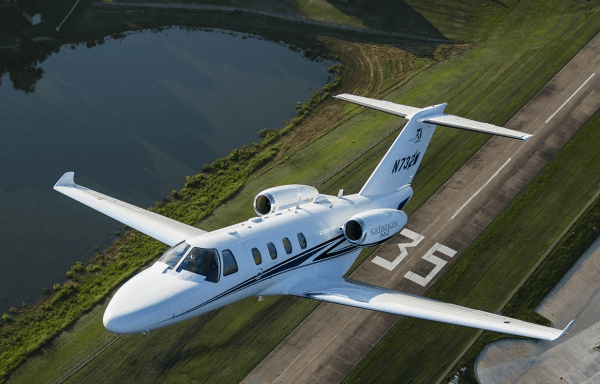
Quick facts
- Location
- KPTK · Waterford, Michigan
- Certification
- FAA-certified repair station
- Jet maintenance
- Citation CJ family · Williams FJ44
- Engine support
- Authorized Williams dealer · TAP / TAP Blue
Technical risk
What sets a business jet paint job apart
A jet repaint carries more technical risk than a cosmetic refresh, and a flight department should expect the shop to manage it in writing.
- Flight-control balance and flutter. Every flight control removed for paint must be balanced to the maintenance manual before reinstallation. Paint weight on a control surface changes its balance, and manufacturers treat flutter seriously: on some large-cabin jets, the FAA has required operators to measure paint thickness on the ailerons, rudder and elevators and correct anything over the limit before further flight.
- Paint thickness within limits.A good shop measures dry film thickness and keeps it within the manual's limits, which also reduces cracking.
- RVSM-sensitive areas.Static ports and the skin around them are part of the aircraft's altitude-keeping performance. Jets typically get a pre-RVSM check on arrival so the condition of these areas is documented before work begins.
- Composite panels, lightning mesh and static wicks. Many business jets mix aluminum and composite structure. Some composite panels carry a metal mesh for lightning protection; when it corrodes, the paint can bubble in a checkerboard pattern, and the repaint is the time to repair it.
- Weight and balance, records and return to service. The job should close with updated weight and balance and a maintenance entry approving the aircraft for return to service.
Scheme trade-offs
High-end paint schemes for corporate jets
A distinctive scheme is achievable, but each design choice affects cost, downtime and long-term upkeep. Plan the scheme with those trade-offs in view:
| Choice | What it gives you | What to plan for |
|---|---|---|
| Basecoat/clearcoat system | Deep gloss that holds longer; clear layer adds UV and oxidation protection; clear damage can often be repaired without remixing the color | Higher material cost; glossy finishes reveal any prep flaws |
| Metallic and pearl colors | Depth and a premium look | Added cost per stripe and potential supply lead time; batch-to-batch matching needs care |
| Multiple stripes and split base colors | A custom livery | Each color adds masking and drying time |
| Matte or satin finishes | A distinctive, current look | Touch-ups show and some reworks aren't possible, so the whole job must be right the first time; matte-specific cleaners required |
| Mostly white base | Easy touch-ups and heat reflection | A more conservative look |
Finalize the scheme 30 to 60 days before the aircraft arrives so materials can be ordered and masking can be planned.
Citation operators
For Citation operators
Michigan Aviation's maintenance team works on the full Citation CJ family, from the CitationJet through the CJ4, and services the Williams FJ44 engine family. That lets a Citation operator plan paint downtime alongside other work on the same field:
- Inspections coming due, including corrosion-related inspection items, can be reviewed when you request a paint slot so they can be scheduled during the same downtime.
- Squawks found during the incoming inspection can go straight to the maintenance team on site.
- FJ44 engine events covered by Williams TAP or TAP Blue can be coordinated through an authorized Williams dealer.
Learn more about Citation and FJ44 maintenance at KPTK.
Downtime
Planning paint downtime for a flight department
Downtime is the cost operators feel most. A few habits keep a jet paint project predictable:
- Book early.Large paint providers commonly ask for three to four months' notice. Reserve your slot as soon as the downtime window is known.
- Expect a range, not a date. Published estimates for light jets range from about two weeks to four or five weeks, and midsize jets often run five to six weeks, depending on the source and the scheme. Read aircraft paint cost and downtime in Michigan.
- Disclose what you know. Known corrosion, previous repairs and squawks should be in the request so they can be planned rather than discovered.
- Agree on change approvals. Decide who on your team can approve additional work, and ask for findings and cost in writing before work expands.
- Ask for regular updates at fixed points: after the strip, after corrosion inspection, after primer and before release.
- Inspect before you sign. Walk the aircraft at delivery for runs, fish-eye, orange peel and overspray, review the balance records and weight and balance, and confirm the warranty terms in writing.
Running more than one aircraft? See the fleet section below.
Fleet programs
How to choose a paint shop for a fleet refurbishment
For a multi-aircraft program, the key factors are the ones that keep tails consistent and the rest of the fleet flying:
Certification. An FAA Part 145 repair station whose airframe ratings cover every type in the fleet. Airframe ratings are issued by class, covering small or large aircraft of composite or all-metal construction, and limited and make-and-model ratings also exist.
Type experience. Recent work on your models, with references from operators who fly them.
Slot sequencing. Committed dates for every tail. A one-at-a-time rotation keeps the rest of the fleet available; AIN reported in 2022 that one operator repainted five Embraer Phenoms that way, about a month each, in the same palette.
Color consistency. The same OEM-approved paint system and color codes on every aircraft. Paint makers offer color matching; AkzoNobel cites a library of more than 10,000 colors.
Environmental control. Steady booth temperature and humidity. Booth type (downdraft or cross-flow) is debated, so judge finished aircraft instead.
Documented quality checks. Paint thickness, control-surface balance, weight and balance and a final inspection, with the same records for every tail. Twin & Turbine (2026) suggests considering a third-party post-paint inspection.
Change approvals. A written estimate before any added corrosion work, one named approver on your side with a response deadline, and findings from the first aircraft used to set the allowance for the rest.
Warranty. One MRO's published guide lists 2–3 years or 1,500 hours as typical, and a 2026 Twin & Turbine account saw quotes from 1 to 5 years. Compare the conditions, not just the length.
Communication. Status reports at fixed points for each aircraft.
Location. Ferry time for every tail, and the cost of return trips for small fixes, which AvWeb notes is lower with a nearby shop.
Stability. References and financial standing, because the shop has to stay in business through the last tail.
Quote structure. All-inclusive or itemized, with exclusions listed so quotes can be compared line by line.
Booking
How to book a business jet paint slot
Send the following through our contact page, by email at fly@michiganaviation.com, or call (248) 666-3440:
- Aircraft make, model, serial number and tail number
- Desired scheme, or a designer's drawings if you have them
- Current paint condition, with photos of any bubbling, cracking or peeling
- Known corrosion, damage or recent repairs
- Inspections, interior or avionics work you want to combine
- Your downtime window and the latest return-to-service date that works for your schedule
We'll confirm the scope for your aircraft and provide a written estimate and schedule.
FAQ
Frequently asked questions
Does Michigan Aviation paint business jets?
Yes. Michigan Aviation performs paint work at its FAA-certified repair station at KPTK in Waterford, Michigan. Send the make, model and scheme for your jet so the team can confirm the scope and schedule for your aircraft.
How do I book a paint slot for a corporate jet in Michigan?
Contact Michigan Aviation through the booking page, at fly@michiganaviation.com or at (248) 666-3440 with your tail number, scheme, current paint condition and downtime window. Booking several months ahead gives the best chance at your preferred dates.
Can you paint a jet with metallic colors or a custom livery?
Custom liveries, metallics and multiple stripes are possible, but each adds cost and time. Finalize the design 30 to 60 days ahead so materials can be ordered and the masking plan built before the aircraft arrives.
Can paint downtime be combined with Citation maintenance?
Yes, that's a main reason operators paint where their jet is maintained. Inspections and squawks can be reviewed when you request the slot, and Michigan Aviation services the Citation CJ family and Williams FJ44 engines on the same field at KPTK.
What should an operator look for in a paint shop for a fleet refurbishment?
Start with Part 145 ratings that cover every type in the fleet and recent work on your models. Then compare committed slot dates for each tail, color consistency across aircraft, documented quality checks, written approval for added corrosion work, warranty terms and how far each aircraft has to ferry.
What should a flight department check before accepting a freshly painted jet?
Walk the aircraft for runs, fish-eye, orange peel and overspray. Review the flight-control balance records, updated weight and balance and the return-to-service entry, and confirm the written warranty terms.
Related services
- Aircraft painting in Michigan
- Cessna Citation and Williams FJ44 maintenance
- Hangar rental and leasing at KPTK
Last updated: Oct 17, 2026