Avionics at KPTK
Avionics Repair & Installation at KPTK
Aircraft avionics maintenance and avionics installation in Michigan at Oakland County International Airport (KPTK). Discuss troubleshooting, repairs and upgrade plans for piston and corporate aircraft with Michigan Aviation.
Discuss avionics work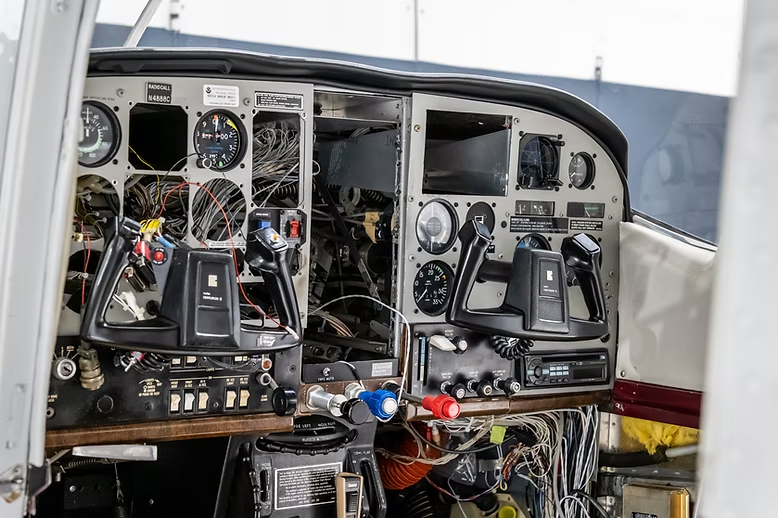
Quick facts
- Location
- Oakland County International Airport (KPTK), Waterford, Michigan
- Authorized service centers
- Garmin service center; Williams International dealer
- Repair station
- FAA Part 145 repair station KL2R956K, Radio Class 1, Class 2, Class 3
- Maintenance coordination
- Avionics and airframe work coordinated on site at KPTK
Where does avionics troubleshooting start?
Start with the symptoms and the installed equipment. Send the aircraft model, equipment list, fault messages and the conditions under which the problem appears. Confirm repair capability and assessment availability before arrival.
Diagnosis may involve power supplies, grounds, wiring, connectors and interfaces as well as the suspected unit. The avionics lead must confirm the appropriate test scope and any repair or exchange recommendation.
How do I plan an upgrade for a piston or corporate aircraft?
Begin with your aircraft configuration, operating needs and budget. Identify what should be retained, what needs replacing and whether the project must be coordinated with scheduled maintenance.
Piston panel projects and corporate suite upgrades need aircraft-specific compatibility and approval review. Equipment selection, interfaces, installation data, testing and documentation can affect the final scope and downtime; confirm these before ordering.
For coordinated visits, see aircraft maintenance at KPTK.
What avionics do you install and service?
Michigan Aviation handles avionics troubleshooting, repair, panel upgrades and full suite integration at KPTK. That covers displays, autopilots, navigation and communication radios, transponders, audio panels, engine indication, datalink weather and traffic, plus the wiring, adapters and documentation that tie an installation together.
We also perform the recurring tests that keep an IFR panel legal, every 24 calendar months under FAR 91.411 and 91.413:
- Pitot-static checks — static system leak testing under Part 43 Appendix E.
- Altimeter checks — altimeter accuracy and altitude reporting correspondence testing.
- Transponder checks — transponder testing under Part 43 Appendix F.
The Garmin TXi family of touchscreen flight displays is one of the lines we work with most, including:
- G500 TXi — flight displays for Part 23 Class I/II piston aircraft, from a single PFD to a PFD/MFD pair.
- G600 TXi — flight displays for higher-performance piston and turbine aircraft, including multi-display panels.
- EIS engine indication — TXi engine indication on a dedicated display or alongside flight data, where applicable to the aircraft.
- GAD 43 and GAD 43e adapters — installation, configuration and software updates that let many legacy autopilots work with TXi glass.
- Existing TXi installations — configuration changes, added displays, and the GAD 43e software update affecting G500 TXi, G600 and G700 systems.
Which TXi configuration fits depends on aircraft eligibility, panel space, existing equipment and autopilot integration. See Garmin G500/G600 TXi upgrades for details, or compare options in our AXIS vs G3X Touch vs G500 TXi comparison.
We work well beyond TXi as well, including Garmin AXIS, G3X Touch and GFC 500/600 autopilots, along with other manufacturers' equipment and the legacy radios and instruments already in the panel. If you do not see your equipment listed, ask — tell us the aircraft and what is installed, and we will confirm what we can support.
Garmin upgrades for light jets at KPTK
Michigan Aviation is an authorized Garmin service center and installs the following Garmin upgrades on light jets at KPTK.
- Cessna Citation CJ1 (serials 525-0360 to 525-0558) — Garmin G600 TXi flight displays with TXi engine display, GTN Xi navigators, GFC 600 autopilot and GI 275 standby, installed as Garmin's complete CJ1 retrofit package.
- Cessna Citation CJ2 (serials 525A-0001 to 525A-0299) — Garmin G600 TXi flight displays with TXi engine display, GTN Xi navigators, GFC 600 autopilot and GI 275 standby, installed as Garmin's complete CJ2 retrofit package.
Eligibility for your aircraft still depends on its serial number, existing equipment and the applicable approval data, so confirm the configuration before ordering.
How does FAA approval work for a new avionics installation in a piston aircraft?
The approval path depends on the aircraft and the specific alteration; buying approved equipment does not by itself approve its installation. An applicable Supplemental Type Certificate (STC) may provide the approval basis, while an eligible alteration may use a field approval. The installer must determine the applicable data, installation requirements, testing and return-to-service records before work begins. Not every installation requires a new STC or a field approval.
FAA references: Supplemental Type Certificates and Field Approvals.
What does a corporate avionics suite integration involve?
Integration starts with the aircraft's existing configuration and the proposed system interfaces, not just a list of replacement boxes. The scope can include displays, navigation, communications, autopilot interfaces, wiring, electrical loads, software compatibility, installation approval data and ground or flight testing where required. Aircraft-specific approvals, documentation and operating limitations must be resolved before return to service.
The FAA explains how an STC addresses both a modification and its effect on the original design in its Supplemental Type Certificate guidance.
How do you source hard-to-find avionics components?
The proposed sourcing process starts with the exact part number, modification status and aircraft applicability, followed by a search through manufacturer and qualified supplier channels. Before installation, the avionics lead must verify the component's eligibility, condition and supporting traceability records. Any substitute, exchange or repaired unit needs aircraft-specific review; availability alone does not establish eligibility. Confirm Michigan Aviation's supplier and acceptance process before ordering.
See the FAA’s Suspected Unapproved Parts program for guidance and unapproved-parts notifications.
What should I send with an avionics request?
Send the aircraft make, model and serial number, current panel photos, equipment model and part numbers, relevant installation records, symptoms or upgrade goals, and preferred dates. Contact Michigan Aviation to confirm scope and scheduling before purchasing equipment or arranging travel.
What else should I know?
How does FAA approval work for a new avionics installation in a piston aircraft?
The approval path depends on the aircraft and the specific alteration; buying approved equipment does not by itself approve its installation. An applicable Supplemental Type Certificate (STC) may provide the approval basis, while an eligible alteration may use a field approval. The installer must determine the applicable data, installation requirements, testing and return-to-service records before work begins. Not every installation requires a new STC or a field approval.
What does a corporate avionics suite integration involve?
Integration starts with the aircraft's existing configuration and the proposed system interfaces, not just a list of replacement boxes. The scope can include displays, navigation, communications, autopilot interfaces, wiring, electrical loads, software compatibility, installation approval data and ground or flight testing where required. Aircraft-specific approvals, documentation and operating limitations must be resolved before return to service.
How do you source hard-to-find avionics components?
The proposed sourcing process starts with the exact part number, modification status and aircraft applicability, followed by a search through manufacturer and qualified supplier channels. Before installation, the avionics lead must verify the component's eligibility, condition and supporting traceability records. Any substitute, exchange or repaired unit needs aircraft-specific review; availability alone does not establish eligibility. Confirm Michigan Aviation's supplier and acceptance process before ordering.
Do you install Garmin avionics in light jets?
Yes. Michigan Aviation is an authorized Garmin service center and installs Garmin's complete retrofit package on the Cessna Citation CJ1 (serials 525-0360 to 525-0558) and CJ2 (serials 525A-0001 to 525A-0299) at KPTK. That package covers G600 TXi flight displays with TXi engine display, GTN Xi navigators, the GFC 600 autopilot and GI 275 standby. Eligibility for a given aircraft still depends on its serial number, existing equipment and the applicable approval data, so confirm the configuration before ordering.
To connect equipment comparisons and aircraft eligibility with installation planning, explore Garmin AXIS installation planning, Garmin G3X Touch retrofit services, Garmin G500 and G600 TXi upgrades, Garmin GFC 500 and 600 autopilot installations, how to check Garmin AXIS aircraft compatibility and the AXIS, G3X Touch and G500 TXi comparison.
For warning signs, a specific equipment update and the service discussion that follows, see five signs avionics need attention before IFR flying and what owners should check in the Garmin GAD 43e software update.
Last updated: